
Best Autism Learning Toys for Meaningful Play
September 22, 2026
A toy can become much more than a way to pass the afternoon. The best autism learning toys create small, repeatable opportunities for a child to communicate, practice a new skill, manage sensory needs, and share enjoyable moments with family. The right choice is not necessarily the toy with the most features. It is the one that matches your child’s current interests, developmental goals, and comfort level.
For many families, a full toy shelf can feel overwhelming when they are trying to support communication, play, independence, or emotional regulation. A few thoughtfully chosen materials, used consistently and without pressure, are often more helpful than an overflowing bin of toys. Below are practical ways to choose learning toys that can support meaningful play at home.
What Makes a Learning Toy Helpful for an Autistic Child?
A helpful learning toy gives a child a clear reason to engage. It may invite them to request help, take a turn, copy an action, solve a problem, or complete part of a familiar routine. It should be enjoyable enough that your child wants to return to it, while offering an appropriate level of challenge.
There is no single toy that is best for every autistic child. Autism is a spectrum, and children have different communication styles, sensory preferences, motor abilities, and interests. A child who loves letters may be highly motivated by magnetic alphabet pieces, while another may be more engaged by animal figures, vehicles, music, or movement. Following those interests is not “giving in.” It can be a thoughtful starting point for teaching.
In ABA therapy, clinicians often use preferred items and activities to help build communication, social engagement, daily living skills, and flexible play. At home, parents can use the same general principle: begin with something your child already enjoys, then add one small learning opportunity at a time.
Best Autism Learning Toys by Skill Area
Toys That Encourage Communication
Cause-and-effect toys are especially useful for early communication because they create a natural reason for a child to ask for more, request help, or share attention. Think of toys with a simple action and an exciting result, such as pop-up toys, wind-up toys, bubble play, ball ramps, or toys that activate with a button or switch.
You do not need to require a child to say a full word before continuing the activity. Communication can include pointing, reaching, looking toward an item, handing over a picture, using a speech-generating device, signing, or attempting a word. Pause briefly before restarting the toy and give your child a chance to communicate in the way that is accessible to them.
Pretend-play sets can also support language development when they match a child’s interests. A play kitchen, doctor kit, animal set, or toy garage may offer opportunities to name items, follow simple directions, and practice action words such as “open,” “go,” “eat,” and “help.” Keep the language simple and connected to what your child is doing in that moment.
Toys for Fine Motor and Problem-Solving Skills
Fine motor toys can make practice feel purposeful. Large interlocking blocks, simple puzzles, shape sorters, stacking cups, pegboards, lacing activities, and beginner construction sets may help children practice grasping, placing, matching, and coordinating both hands.
The best level of difficulty depends on the child. If a puzzle is too hard, frustration can quickly replace learning. If it is too easy, there may be little reason to stay engaged. Look for a task your child can complete with some success while still needing a little support. You might begin by handing over one piece at a time, modeling where it goes, or offering a brief gesture prompt.
It is also helpful to remember that completing a toy “correctly” is not the only goal. A child who lines up blocks, groups puzzle pieces by color, or repeatedly opens and closes a container may be showing a genuine interest that can be expanded gradually. You might add a turn, introduce one new action, or offer a simple choice without taking away the enjoyment of the activity.
Sensory Toys for Regulation and Focus
Sensory tools can support regulation when they are chosen thoughtfully. Some children enjoy fidget items, textured materials, kinetic sand, water play, weighted lap items, chewable sensory tools designed for that purpose, or visual toys with gentle movement. Others find the same materials distracting or uncomfortable.
Sensory preferences are personal. More stimulation is not always better. A toy with bright lights, loud sounds, and multiple moving parts may be exciting for one child but overwhelming for another. Pay attention to what happens before, during, and after play. Does your child appear calm and organized? Are they able to engage longer? Or do they become distressed, cover their ears, throw the toy, or move away?
For children who are sensitive to sound, simple toys without electronic noise may be a better fit. For children who seek movement, a small indoor trampoline, balance stepping stones, or a soft ball may provide a more appropriate outlet than a tabletop activity. Any movement equipment should be supervised and selected with safety in mind.
Toys That Build Social Play and Turn-Taking
Shared play does not have to begin with a complicated board game. In fact, simple routines are often more successful. Rolling a ball back and forth, taking turns adding blocks to a tower, playing with a car ramp, or placing pieces in a toy together can teach the early foundation of waiting, watching, responding, and enjoying another person’s involvement.
Choose an activity with a quick turn and a clear ending. Long waiting periods can be difficult for young children or children who are still learning to tolerate delays. You can use short phrases such as “my turn,” “your turn,” and “again,” while keeping the pace fun. If your child is not ready to wait, begin by joining their play for only a few seconds rather than insisting on a formal turn-taking rule.
Games with simple matching, memory, or cooperative goals can be introduced later when a child can attend for longer periods. The goal is not to force social interaction. It is to help a child experience play with another person as predictable, safe, and enjoyable.
Toys That Support Daily Living Skills
Some of the most valuable learning materials are practical items that resemble real-life tasks. Child-safe pretend food, dress-up dolls, toy cleaning sets, toy tool kits, and play bathroom routines can help children become familiar with everyday sequences. For example, a doll can be used to practice putting on socks, brushing hair, washing hands, or preparing for bedtime.
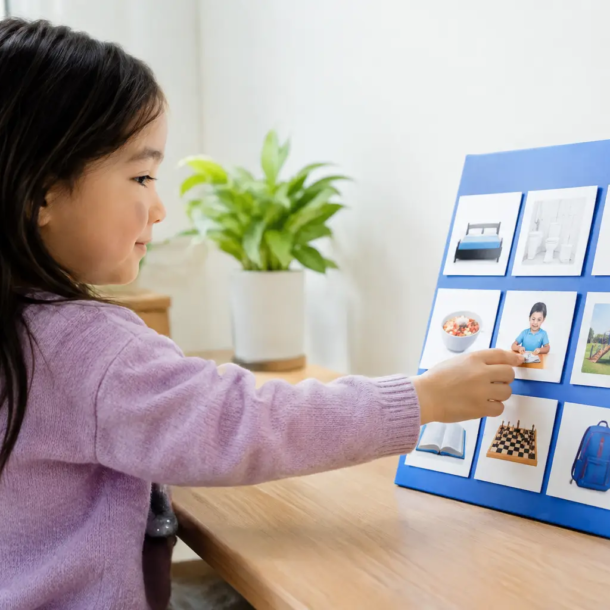
Visual routines may be more useful than a traditional toy for some children. A simple sequence of pictures paired with the real materials can support tasks such as putting away toys, getting dressed, packing a backpack, or washing hands. The learning becomes more meaningful when it transfers from play to everyday life.
How to Choose Toys Without Overspending
Before buying a new toy, consider what your child is working on right now. A child developing early requesting skills may benefit from motivating cause-and-effect toys. A child practicing tolerance for shared play may need a favorite activity that can be easily repeated with an adult. A child building independence may benefit more from child-sized practical materials than from another electronic toy.
It can help to look for toys that have more than one way to use them. Blocks can support fine motor skills, imitation, colors, counting, turn-taking, and pretend play. Animal figures can support vocabulary, sorting, sounds, movement, and simple stories. Open-ended toys often last longer because they can grow with the child.
Safety matters as much as educational value. Check age recommendations, avoid small parts for children who mouth objects, inspect toys for broken pieces, and supervise activities that involve water, sensory materials, movement, or items that could be chewed. If your child has specific sensory, feeding, motor, or safety needs, their care team can help you identify appropriate options.
Using Toys in a Way That Supports Learning
The toy itself is only part of the experience. How it is introduced matters. Set aside a short period of play without competing distractions, join your child at their level, and observe what they enjoy. Narrate the play with a few relevant words rather than asking many questions or giving frequent instructions.
When your child is engaged, create a small opportunity for participation. Hold back one piece, pause before activating a favorite toy, or offer two choices. Then respond warmly to any appropriate attempt to communicate. This helps a child learn that communication has a meaningful effect.
Avoid turning every moment of play into a test. Children need time to explore, repeat actions, and enjoy their interests. Learning tends to be stronger when a child feels successful and connected, not pressured to perform.
When Extra Guidance Can Help
If you are unsure which toys fit your child’s goals, ask your child’s ABA team to help you identify a few materials that can be used at home. A behavior analyst may suggest ways to use preferred toys to practice communication, adaptive skills, or social engagement while respecting your child’s individual needs. For families in Broward, Palm Beach, or Lee County, Bhavioral Corporation can help parents understand how individualized ABA programming supports skills that matter in daily life.
The most meaningful toy may be one your child already owns and loves. Start there, stay curious about what motivates them, and let each small moment of shared play become an opportunity to build confidence, connection, and independence.